Cooperative Clouds: How LaSuite.coop Is Building a New Model for Digital Sovereignty
We are living through what many in our community have started calling the Digital Coup: the accelerating concentration of digital infrastructure in the hands of a shrinking number of billionaire-controlled corporations, increasingly allied with authoritarian politics. The response cannot simply be better regulation or gentler procurement. It requires an alternative economy — one built on public values, cooperation, and the commons.
That is precisely the spirit behind our regular community call series, and it is why we were delighted to welcome LaSuite.coop as our special guests on 11 May 2026.
The Moment We Are In
The context matters. For the first time in years, there is real political momentum at the European level for breaking with Big Tech dependency. Under the umbrella of the Digital Commons EDIC (European Digital Infrastructure Consortium), France, Germany, the Netherlands, and other member states are collaborating to develop open-source collaborative workspaces for their civil servants: La Suite in France, OpenDesk in Germany, MijnBureau in the Netherlands.
This is not a minor procurement shift. France’s digital infrastructure agency, DINUM, has taken the remarkable step of editing and maintaining free software as a digital common — rather than contracting out to proprietary vendors or even relying on existing open-source projects managed by private entities. Hundreds of thousands of French public agents are already using these tools. Every one hundred day’s sprint, the software takes a significant leap forward.
This changes the economics of cooperative cloud provision. The technical work is increasingly done; the public investment is already flowing. What the ecosystem now needs is the social infrastructure to make it last: hosting cooperatives, training providers, community governance, and — crucially — a replicable organisational model.
Enter LaSuite.coop.
What Is LaSuite.coop?
LaSuite.coop is a multi-stakeholder cooperative being established in France by a consortium of long-standing cooperative actors in the digital space. Its founding members include IndieHosters (free software hosting, over 10 years of experience), Yaal.coop (cooperative software developers), Algoo/Galae (email hosting), and Lebureau.coop (domain names), with further collaboration from Open Source Politics .
The cooperative is currently completing its legal incorporation — the entity will be formally constituted in June 2026 — and is running a public campaign to bring in customers, partners, and supporters as co-owners before launch.
The service is already operational (join as member and/or access their demo). LaSuite.coop offers organisations a complete collaborative workspace built on the tools developed and integrated by DINUM:
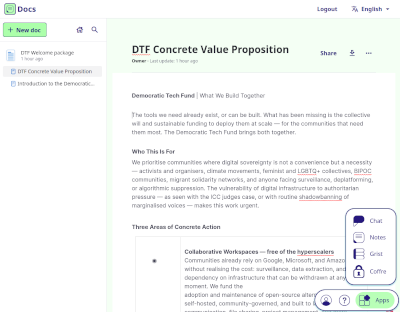
- Docs — collaborative document and note editing
- Visio — video conferencing
- Grist — a powerful low-code/no-code spreadsheet and database tool (think Airtable, but open source)
- Element/Matrix — encrypted team chat
- File sharing — sovereign cloud storage (coming soon)
- Mail — hosted email based on Mailcow and SOGo
- Additional tools — password vaults, website hosting, and more
Pricing follows a t-shirt size model (10–25 users, 25–50, 50–150, and above), designed around organisations rather than individual licences, with the explicit intention of avoiding the per-seat nickel-and-diming that makes Microsoft and Google so sticky. For very small groups or those who wish to self-host, the tools are open source and documented — though they require a degree of technical confidence to set up independently.
Why Open Source Alone Is Not Enough
Tim - Timothée Gosselin -, one of LaSuite.coop’s founders, made a point in our community call that deserves to be heard beyond the cooperative tech circles where it is already well understood.
Open source removes technical lock-in. It offers legal freedom and transparency. But it does not, by itself, confer sovereignty. The history of open-source projects is littered with examples of licence changes, community capture, and the slow drift of decision-making power towards whoever controls the funding — not because of bad intentions, but because of misaligned incentives.
“Open source without shared governance is just transparent dependency,” as Tim put it.
What actually determines sovereignty is who decides — who sets the roadmap, who chooses the pricing, who determines which users are served and how. Those decisions are made through governance, not licensing.
LaSuite.coop’s answer is to combine three things that each on their own are insufficient:
- Free software — for technical freedom and transparency
- The commons — shared governance over the code itself, independent of any single organisation or state
- The cooperative model — a business structure whose incentives are aligned with users and workers, not with capital accumulation
This three-part combination is the core of what LaSuite.coop calls its blueprint for European digital sovereignty.
A Governance Model Worth Studying
The cooperative form that LaSuite.coop is adopting is a Société Coopérative d’Intérêt Collectif (SCIC) — a French legal structure requiring both workers and customers to be represented in governance. This is not a common worker co-op, nor a user co-op in the conventional sense. It is a multi-stakeholder structure, and LaSuite.coop has elaborated it further into five membership categories, each with a defined share of voting power:
- Service operators (IndieHosters, developers, trainers, support) — 30%
- Organisational customers — 20%
- Individual customers — 20%
- Strategic partners (organisations connected to the ecosystem) — 20%
- Supporters — 10%
The design principle is clear: the largest share of decision-making power sits with those who produce and those who use the service — not with investors, not with the state, not with a founding clique. There is no single actor who can decide unilaterally.
Crucially, the cooperative intends to dedicate a share of its revenues back to the upstream commons — contributing financially to La Suite’s development, funding community events and hackathons, and participating in the governance of the common codebase itself. LaSuite.coop is not a free rider on the public investment that made these tools possible; it aims to be a net contributor.
Built to Be Replicated
Perhaps the most significant aspect of LaSuite.coop, from the perspective of the broader cooperative tech movement, is that it is designed from the outset to be copied.
The technical infrastructure (open source, documented), the organisational model (the SCIC structure with its membership categories and governance rules), the economic model (t-shirt pricing, revenue redistribution, no venture capital) — all of it is being developed transparently and will be shared publicly. As Tim said: “We hope others can try on their side and we can learn together from our mistakes and our successes.”
This is not a French project that happens to use open-source tools. It is a blueprint that could be adopted in Germany, the Netherlands, Spain, Belgium, or anywhere else where the political and technical conditions are ripening. The Digital Commons EDIC provides a European-level coordination layer. The CoopCloud Federation provides a technical commons of cloud operators. What is needed now is the proliferation of LaSuite.coop-style cooperative service providers across the continent, working together as an ecosystem rather than competing as isolated startups.
The risk is real and Tim named it plainly: DINUM could face a change in political direction; funding could be cut; the private software lobby — which is already pushing back hard against La Suite as “unfair competition” — could win ground. The resilience of the commons depends on building an ecosystem of actors, cooperative and civic, whose existence does not depend on any single government’s goodwill.
What This Means for Us
At the Free Knowledge Institute, we have been working for twenty years on the mission of spreading free knowledge models and democratic tech — technology cared for by the communities it serves. We co-founded CommonsCloud.Coop in Barcelona. We were among the first members of Meet.coop. We are co-initiators of the Democratic Tech Fund, a bottom-up collective fund for the transition to digital autonomy.
We see LaSuite.coop as exactly the kind of initiative the Democratic Tech Fund exists to support and connect. The question is not whether this model is the right one. The question is whether we can move fast enough, and build collectively enough, to make it viable at the scale it needs to reach.
Let Us Know Your Interest
We want to build on the momentum of this community call. Specifically, we are exploring:
- Replication of the LaSuite.coop model in other European countries — whether as national cooperatives, regional networks, or sector-specific instances (media, civil society, education, local government)
- Collective funding through the Democratic Tech Fund to support the social infrastructure — community management, onboarding support, governance design — that cooperative cloud providers need to grow
- A shared roadmap connecting LaSuite.coop, the CoopCloud Federation, Lokal-IT, KolliCloud, and other emerging cooperative cloud providers into a genuinely interoperable European ecosystem.
If you are running or planning a cooperative or commons-based digital infrastructure project, if your organisation is looking to move away from Big Tech tools and wants to do so collectively, or if you simply want to support this work — we want to hear from you.
Get in touch via the Democratic Tech Fund, join the conversation in our Matrix space (look for the Our Desk channel), or follow us on the Fediverse. You can also support the Democratic Tech Fund directly via Open Collective.
The tools are ready. The model is proven. What we need now is the collective will to build it — together.
The Free Knowledge Institute community call with LaSuite.coop took place on 11 May 2026 via Meet.coop, organised with the Democratic Tech Fund and the CoopCloud Federation. The recording and transcription are available.
This call series is irregular, but ongoing. Our next session — featuring Lokal-IT and KolliCloud — takes place on 21 May 2026 at 14:00 CEST via Meet.coop.