Democratic Technology: Building Alternatives to Techno-Authoritarianism
Acknowledgements
My thankfulness goes to Sophie Bloemen for her review of this article and her many suggestions for improvement. Also Mike Hales has enriched this work through the many conversations we’ve been having over the years about commoning, about tooling for organisers and economic democracy. With both I share a long time thinking of the possibility of organising a democratic tech fund. And of course to all who are participating in the many intersectional communities doing their part to make this world a better place from the bottom-up, using technology, not on their, but on our terms.
Introduction
With authoritarian politics increasingly aligning with tech billionaires—Elon Musk, Jeff Bezos, Mark Zuckerberg, and Peter Thiel amongst others—our democratic societies face unprecedented risks. Democratic technology offers a counter-vision: technology that supports democracy, that can be owned by communities, and through which we can shape our lives collectively rather than being subjected to extractive systems that increasingly put life on earth at risk.
Whilst the term “democratic tech” has risen rapidly in recent times, particularly as society awakens to its counterpart—authoritarian tech—its intellectual roots run deep. More importantly, various communities use the term with different meanings and connotations. This article traces the history of democratic technology, explores its contemporary applications, and articulates our position on what democratic tech means in the struggle against platform capitalism.
Historical Foundations and Key Thinkers
Lewis Mumford: Authoritarian versus Democratic Technics
Lewis Mumford, sociologist and philosopher of technology, provided one of the earliest and most influential conceptualisations in his 1964 essay “Authoritarian and Democratic Technics.”1 Mumford distinguished between two fundamental approaches to technology: authoritarian technics, characterised by centralised control and large-scale systems, versus democratic technics, which he defined as:
the small-scale method of production, resting mainly on human skill and animal energy but always, even when employing machines, remaining under the active direction of the craftsman or the farmer, each group developing its own gifts, through appropriate arts and social ceremonies, as well as making discreet use of the gifts of nature.
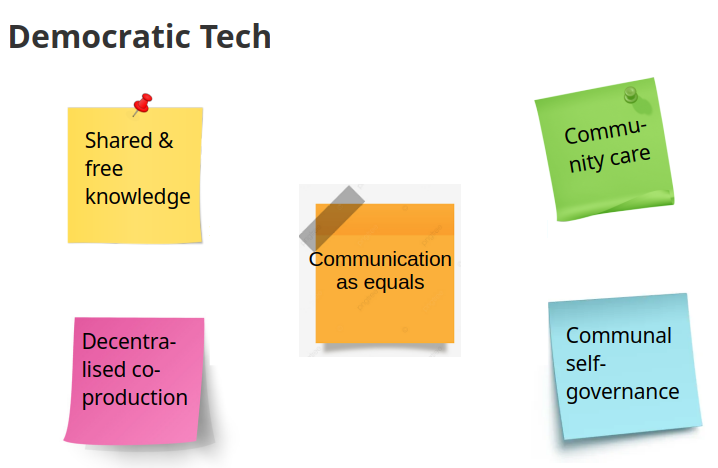
Around this central principle of democracy—giving final authority to the whole rather than the part, to living human beings rather than institutions—Mumford identified a constellation of related ideas and practices: communal self-government, free communication amongst equals, unimpeded access to the common store of knowledge, protection against arbitrary external controls, and individual moral responsibility for behaviour affecting the whole community.
Mumford observed that “democracy is necessarily most visible in relatively small communities and groups, whose members meet frequently face to face, interact freely, and are known to each other as persons.” He warned that “as soon as large numbers are involved, democratic association must be supplemented by a more abstract, depersonalised form.” Presciently, he noted that “it is much easier to wipe out democracy by an institutional arrangement that gives authority only to those at the apex of the social hierarchy than it is to incorporate democratic practices into a well organised system under centralised direction.”
Andrew Feenberg: Critical Theory of Technology
Andrew Feenberg emerged as a central figure in contemporary philosophy of technology, developing what he calls “Critical Theory of Technology” in the 1990s. Feenberg argued that democratising technology means expanding technological design to include alternative interests and values. He asserted that this must be achieved through consumer intervention in a liberated design process.
From his book Transforming Technology, Feenberg writes:
What human beings are and will become is decided in the shape of our tools no less than in the action of statesmen and political movements. The design of technology is thus an ontological decision fraught with political consequences. The exclusion of the vast majority from participation in this decision is profoundly undemocratic.2
Elinor Ostrom: Governing the Commons
Elinor Ostrom, winner of the 2009 Nobel Memorial Prize in Economic Sciences, fundamentally challenged the dominant narrative of the “tragedy of the commons” through her groundbreaking 1990 work Governing the Commons.3 She demonstrated through extensive empirical research that communities can successfully self-organise and self-govern common resources without requiring either privatisation or state control.
Ostrom identified eight design principles characteristic of enduring commons institutions:
- Clearly defined boundaries
- Rules tailored to local conditions
- Participatory decision-making by those affected
- Monitoring by accountable community members
- Graduated sanctions for rule violations
- Accessible conflict-resolution mechanisms
- Recognition of rights to organise by external authorities
- Nested governance structures for larger commons
Application to Digital Commons:
Ostrom’s framework has become foundational for theorising and building democratic digital alternatives to platform capitalism. Her work has been extended to knowledge commons (digital libraries, open access scholarly publishing, scientific data), data commons (collective data governance models), open source software (Wikipedia, GNU/Linux, collaborative development communities), and digital infrastructure (internet governance, radio spectrum).
The key insight is that digital resources—whilst different from natural resources in being non-rivalrous (my use doesn’t diminish yours) and non-depletable—still require democratic governance structures to prevent “enclosure” by corporate interests and ensure equitable access. Organisations like the Mozilla Foundation, Ada Lovelace Institute, Guifi.net Foundation,4 and Ostrom’s own Workshop at Indiana University have adapted her principles for data commons governance, addressing questions of ownership, stewardship, access rights, and collective decision-making in digital contexts.
Critical Voices on BigTech and the Case for Democratic Technology
Surveillance Capitalism and Behavioural Control
Shoshana Zuboff’s The Age of Surveillance Capitalism (2019) defines surveillance capitalism as an unprecedented form of capitalism that unilaterally claims human experience as free raw material for translation into behavioural data, which is then transformed into prediction products sold in behavioural futures markets.5 Companies like Google and Facebook harvest our digital trails to predict and increasingly manipulate our behaviour, creating what Zuboff terms “instrumentarian power”—the capacity to shape human action at scale through digital infrastructure.
Far from being neutral technology platforms, these corporations have built a totalitarian architecture of behaviour modification that threatens human autonomy and democratic society as fundamentally as industrial capitalism threatened the natural environment. Zuboff demonstrates how surveillance capitalism has escaped democratic oversight whilst accumulating extreme concentrations of knowledge and power that undermine the very possibility of a “right to the future tense”—our capacity to imagine, intend, and construct our own futures free from algorithmic manipulation.
Race, Technology, and Algorithmic Oppression
Ruha Benjamin’s Race After Technology (2019) introduces the concept of the “New Jim Code” to expose how discriminatory designs encode inequity in technological systems that claim neutrality and objectivity whilst actually reinforcing white supremacy and deepening social inequality.6 She demonstrates that automation has the capacity to hide, accelerate, and intensify discrimination by explicitly amplifying racial hierarchies, ignoring but thereby replicating social divisions, or paradoxically attempting to fix racial bias whilst ultimately doing the opposite.
Through concrete examples ranging from beauty contest algorithms that overwhelmingly select white winners to predictive policing software that targets Black communities, Benjamin reveals how AI and automated systems systematically exclude marginalised communities. Most provocatively, she argues for understanding race itself as a technology—a tool deliberately engineered throughout history to stratify and sanctify social injustice in the architecture of everyday life. Benjamin concludes with “abolitionist tools” for the New Jim Code, calling for emancipatory technological practices that fundamentally challenge racist social structures.
The Material Costs of AI
Kate Crawford’s Atlas of AI (2021) dismantles the myth of artificial intelligence as immaterial, objective, and inevitable by exposing AI as fundamentally a technology of extraction.7 From the minerals mined from the earth and energy consumed, to the labour exploited in Amazon warehouses and data centres, to the data harvested from every human action and expression without consent, Crawford traces how this “planetary network” concentrates power, fuels undemocratic governance, and deepens environmental degradation and social inequality.
Crawford demonstrates that AI is neither “artificial” (requiring vast human labour, natural resources, and infrastructure) nor genuinely “intelligent” (lacking human capacities for generalisation, common sense, or causal reasoning), but rather a “registry of power” that embeds centuries-old systems of classification, discrimination, and control in new technological forms. She argues that challenging AI’s growing dominance requires moving beyond calls for “AI ethics” to fundamentally questioning the structures of power that AI reinforces.
Algorithmic Discrimination and Inequality
Cathy O’Neil’s Weapons of Math Destruction (2016) exposes how mathematical models and algorithms that increasingly govern critical life decisions are neither neutral nor fair but actively reinforce discrimination and widen inequality.8 She identifies “weapons of math destruction” (WMDs) as algorithms sharing three key characteristics: opacity (inscrutable to those affected), scale (applied to vast populations), and damage (causing significant harm, particularly to the poor and marginalised).
O’Neil demonstrates through vivid case studies how these models create pernicious feedback loops—for instance, predictive policing algorithms that concentrate enforcement in poor neighbourhoods, leading to more arrests there, which the algorithm then interprets as validation for even more intensive policing. The models’ veneer of mathematical objectivity masks the reality that they encode the biases of their creators and the historical data they’re trained on.
Digital Poorhouses and Automated Inequality
Virginia Eubanks’s Automating Inequality (2018) systematically investigates how automated decision-making systems used in public services constitute a “digital poorhouse” that profiles, polices, and punishes poor and working-class people, particularly people of colour.9 Through three devastating case studies, she documents how automation in Indiana’s welfare system literally killed people by cutting benefits as they lay dying, how Los Angeles’s coordinated entry system for homeless services uses algorithms to score neediness whilst sharing data with police, and how Allegheny County’s predictive risk model for child abuse systematically overrepresents Black families.
Eubanks argues that automated systems serve as “empathy overrides,” allowing society to avoid confronting the moral and political challenges of poverty and racism by outsourcing hard decisions to machines. She calls for centring the experiences of those harmed, building cross-class movements led by the poor themselves, and fundamentally redesigning systems from a belief in universal human rights.
Digital Labour and the Cybertariat
Ursula Huws’s Labor in the Global Digital Economy (2014) provides a Marxist-feminist analysis of how information and communications technology has fundamentally restructured global capitalism, creating what she terms the “cybertariat.”10 She demonstrates that far from liberating workers, digital technologies have enabled capital to extend control through the “homework economy,” where work becomes feminised in the sense of being made “extremely vulnerable, able to be disassembled, reassembled, exploited as a reserve labour force,” with boundaries between work and life dissolving under constant technological change.
Feminist Technoscience and the Cyborg
Donna Haraway’s “A Cyborg Manifesto” (1985) uses the cyborg—a hybrid of organism and machine—as a transgressive figure to challenge essentialist identity politics and rigid boundary distinctions.11 She argues that the cyborg represents possibilities for reimagining political solidarity through affinity and coalition rather than through claims to unified identity. Haraway calls for feminists to embrace rather than fear technology, advocating for a politics rooted in transgressing boundaries whilst taking responsibility for their construction.
Three Interpretations of Democratic Technology
The concept of “democratic tech” encompasses several overlapping but distinct approaches:
1. Democratisation of Access to Technology
This interpretation focuses on making technology more accessible rather than changing its governance. The broader concept of “democratisation of technology” refers to the process by which access to technology rapidly extends to an ever-broader audience, from a select group to the average public.
Examples:
- The Internet democratised access to knowledge, as did the invention of the printing press before it
- DIY electronics with Arduino lowered the threshold to participate in high-tech innovation
- Open-source software movements made professional-grade tools available to all
This trend is linked to the spread of knowledge and ability to perform high-tech tasks, challenging previous conceptions of expertise. Since the 1980s, a spreading constructivist conception of technology has emphasised that the social and technical domains are critically intertwined.
Critical Perspective: Astra Taylor, author of The People’s Platform: Taking Back Power and Culture in the Digital Age, argues that “the promotion of Internet-enabled amateurism is a lazy substitute for real equality of opportunity,” suggesting that mere access is insufficient for genuine democratisation.12
2. Democratic Governance of Technology
This approach, initiated by Mumford and championed by Feenberg, emphasises that technologies are neither neutral nor deterministic, but are encoded with specific socio-economic values and interests. This perspective insists that democratising technology requires more than access—it demands genuine participation in technological design and control.
The question is not simply who can use technology, but fundamentally who controls it and who decides how it develops.
3. E-Democracy and Civic Technology
A third interpretation defines “democratic tech” as tools that bring governments and citizens into the 21st century, empowering engagement in real time on daily issues between people and politicians in a seamless and transparent way.
This interpretation focuses on technology’s role in enhancing democratic participation and government transparency, though it often leaves questions of ownership and control unaddressed.
Practices of Democratic Governance Over Technology
Mumford defined democratic tech in terms of communal self-government, free communication amongst equals, and unimpeded access to the common store of knowledge. With the mainstreaming of the internet, different practices of communal governance and production emerged:
Commons-Based Peer Production: Yochai Benkler observed online collaboration of peer producers as a form of “commons-based peer production.”13 Michel Bauwens posed peer production as a third mode of production and peer governance as a third mode of governance, beyond the state and beyond the market.14
Commoning: Silke Helfrich and David Bollier, in their 2019 book Free, Fair and Alive: The Insurgent Power of the Commons, insist on the practice of commoning, discussing “peer governance through commoning.”15
Cooperative Governance: The cooperative governance tradition from the Social and Solidarity Economy, dating back to the 19th century, has demonstrated its importance in society. In cooperative governance, each member has one vote (see the International Cooperative Alliance), providing a practice of egalitarian governance in juxtaposition to the shareholder governance model in most companies.
Platform Cooperativism: Marrying the cultures of commons-based peer production with the cooperativist tradition brought us “open cooperativism” and “platform cooperativism.”
The Platform Cooperative Movement
Trebor Scholz coined the term “platform cooperativism” in a 2014 article titled “Platform Cooperativism vs. the Sharing Economy.”16 He criticised popular so-called “sharing economy” platforms and called for the creation of democratically controlled cooperative alternatives that “allow workers to exchange their labour without the manipulation of the middleman.”
By 2016, Scholz, Nathan Schneider,17 and others had established the Platform Cooperativism Consortium18 on the occasion of the “Building the Cooperative Internet” conference, creating an institutional home for this emerging movement.
A platform cooperative is “a cooperatively owned, democratically governed business that establishes a two-sided market via a computing platform, website, mobile app or a protocol to facilitate the sale of goods and services.” Platform cooperatives are an alternative to venture capital-funded platforms insofar as they are owned and governed by those who depend on them most—workers, users, and other relevant stakeholders.
Besides platform cooperatives, there is also the movement of “steward-owned” businesses, where the legal form of a limited company is used and transformed into a more participatory governance model where different stakeholders are represented in the governance structures.
Contemporary Applications and Movements
Various groups and movements are currently using and advancing democratic technology:
Academic and Philosophical Communities: Philosophy of technology scholars, particularly those influenced by Critical Theory of Technology and Science and Technology Studies (STS).
Platform Cooperative Movement: Organisations like the Platform Cooperativism Consortium help “start, grow, or convert to platform co-ops” based on principles including democratic governance, in which all stakeholders who own the platform collectively govern it.
Policy and Think Tank Networks: The Democratic Tech Alliance,19 founded by people like Robin Berjon and Sophie Bloemen with support from a broad alliance of political parties in the European Parliament, bolsters institutional capacity to see digital infrastructures governed by their stakeholders, to break authoritarian control over tech, and to build infrastructure designed for democracy.
Civic Technology Practitioners: Groups developing tools for citizen engagement and government transparency.
Democratic Technology in Practice: Two Case Studies
Social.coop: Cooperative Social Media with Sociocratic Governance
Social.coop represents a pioneering example of cooperative ownership applied to social media infrastructure.20 Founded in 2017 by Nathan Schneider, Matthew Cropp, and Mayel de Borniol in the wake of the #BuyTwitter campaign, Social.coop is a cooperatively run instance of Mastodon—a decentralised social network based on open protocols and free software operating within the Fediverse.
Growing from 300+ founding members in 2017 to around 500 active users monthly by 2024, Social.coop operates on principles of cooperative ownership and sociocratic governance. Members contribute through sliding-scale subscription payments (£1-£10 per month) and volunteer labour in working groups (called circles in sociocratic terminology). The cooperative uses Loomio—itself a worker-owned cooperative’s platform—for democratic decision-making, and Open Collective for transparent financial management.21
What distinguishes Social.coop is its commitment to genuine democratic governance of digital infrastructure. Members collectively shape community policies, steward their own data, and manage shared technologies. The cooperative explicitly positions itself as part of “cooperative clouds”—organisations combining open-source cloud software with human-scaled cooperative business models—offering a concrete alternative to surveillance capitalism’s “free” model whilst demonstrating how users can maintain control over their social data and interactions through trusted cooperative structures.22
Social.coop’s values—honesty, openness, social responsibility, and caring for others—are embedded in its Code of Conduct and operational practices. The cooperative adheres to the International Cooperative Alliance’s principles whilst experimenting with new forms of technopolitical governance appropriate for federated digital platforms.
Decidim: Civic Tech with Democratic Governance
Decidim exemplifies both civic technology and democratically governed technological infrastructure.23 Developed at Barcelona’s Laboratory for Democratic Innovation and now used by hundreds of organisations worldwide—from cities like Helsinki and Barcelona to regional governments, national states, NGOs, and cooperatives—Decidim is a public-commons, free and open digital infrastructure for participatory democracy.
What makes Decidim particularly significant for democratic technology is not merely its function as civic tech (enabling participatory budgeting, citizen assemblies, collaborative legislation, and other democratic processes) but its own democratic governance. The platform is governed by the Decidim Free Software Association, and more broadly by MetaDecidim—the open community that collaborates in designing the platform and developing the project. Remarkably, Decidim uses itself for its own governance, embodying the principle that democratic technology should be democratically governed.
The Social Contract:
Central to Decidim’s democratic character is its Social Contract,24 which all members of the Decidim community must endorse and follow. This contract establishes binding commitments around:
- Free software and open content: All code must be Free Open Source Software (AGPL v3 or compatible), with open and interoperable standards
- Transparency and traceability: All data related to participatory processes must be available for download and analysis in open formats
- Privacy and data confidentiality: Personal data shall never be transferred to third parties; political preferences remain inaccessible even to administrators
- Democratic quality: Commitment to quality indicators, equal access, and avoiding “participatory washing”
- Accountability: Responding to queries and following up on participatory process results
- Collaborative governance: Democratic self-organisation and control by the community
This Social Contract represents a sophisticated attempt to encode democratic values directly into the governance of technological infrastructure. It demonstrates how communities can establish shared commitments to care for the collective based on explicitly articulated values—moving beyond mere technical features to create binding social relationships around democratic technology.
Decidim thus operates across three dimensions: the political (what kind of democracy it enables), the technopolitical (how it is itself democratically designed and governed), and the technical (the conditions of its production and operation). In a context dominated by corporate platforms and “algorithmic governance,” Decidim stands as a commons-based alternative: publicly supported, democratically designed, and recursively using itself for its own participatory governance.
Our Position: Democratic Tech as Commons and Cooperation
We take the position of the commons, understanding “democracy” as “for and by the people.” Consequently, for “democratic tech” we follow the intellectual lineage of Mumford-Feenberg-Ostrom-Scholz and many other scholars who view democratic technology as fundamentally about who controls technology rather than just who can access it. We could summarise “democratic tech” as the intersection between in particular three movements: the free/libre open source movement, the cooperative social and solidarity economy and the long time human tradition of commoning.
More concretely, and in relation to resistance to tech monopolies, we view democratic tech as having these key elements:
- Community ownership and/or control
- Opposition to surveillance capitalism
- Commons-based development
- Cooperative governance structures
- Transitioning towards collective digital autonomy
Following Lewis Mumford’s definition, we can depict democratic technology as having five core elements that constitute a commons:
- Communal self-government
- Free communication amongst equals
- Unimpeded access to the common store of knowledge
- Protection against arbitrary external controls
- Individual moral responsibility for behaviour affecting the whole community
Our approach explicitly positions itself against BigTech’s extractive models, making it part of the broader movement towards technological sovereignty, digital autonomy, and digital commons.
Concrete Examples of Our Work
The Five Pillar Framework
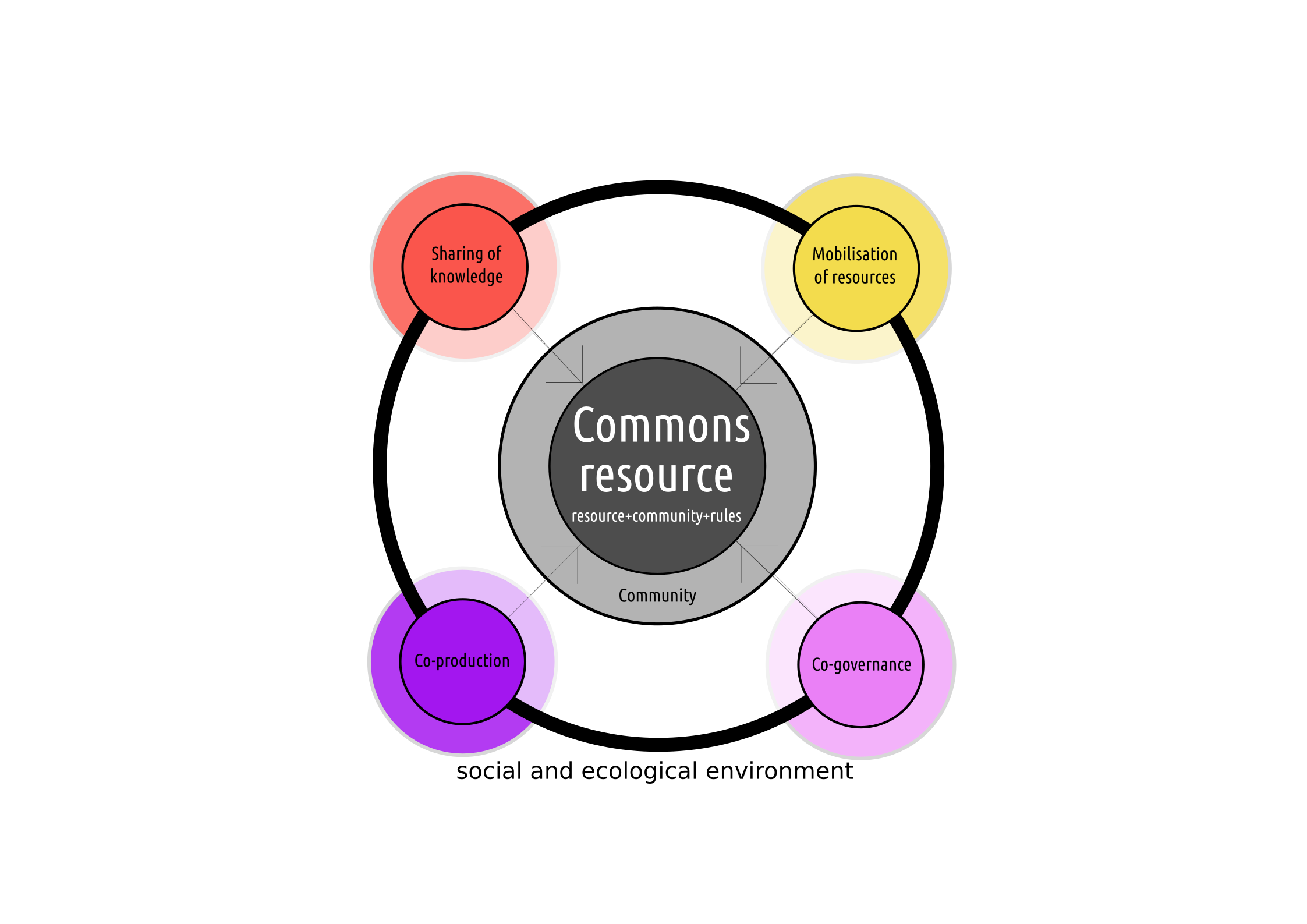
The Free Knowledge Institute has developed a sustainability framework that is community-centred, inspired by many existing democratic tech initiatives. The Five Pillar Model25 provides a commons-based business model framework with five pillars almost identical to Mumford’s definition:
- Shared Knowledge
- Co-governance
- Co-production using Open Source Technologies
- Non-extractive Revenue Strategies
- Community-Driven Shared Mission
Barcelona’s Procomuns Conference
In Barcelona, the FKI signed a Memorandum with the City of Barcelona to establish a working group on Commons Collaborative Economy (called Barcola), together with research group Dimmons, Guifi.net and others. Under the leadership of Mayo Fuster Morell and BarCola we co-organised the Procomuns Conference in 2016, where commons-based peer production and especially platform cooperativism have been the central pillars. This was a starting point for the FKI to organise La Comunificadora, a commons collaborative economy “start-up” programme for the City of Barcelona, to initiate the femProcomuns cooperative and CommonsCloud.coop - a cooperative cloud service to user members, produced by worker and collaborator members.
Roadmap to Sovereign Tech (Netherlands)
 Commons Network has developed a Roadmap to Sovereign Tech anchored in digital commons.26 This roadmap was commissioned by the Ministry for Digital Affairs in the Netherlands, following a year-long series of workshops with stakeholders from the digital commons sector, public institutions, and representatives from various ministries. The three key action lines are:
- Investing in public digital infrastructure
- Facilitating sustainable and democratic business and organisational models
- Increasing public awareness and digital skills
Roadmap for Democratic Tech (Amsterdam)
Commons Network and Waag Futurelab have developed a “Roadmap for Democratic Tech for the community economy and broader social economy in the city,” commissioned by the City of Amsterdam.27
Why This Matters Now
In the current context of platform worker exploitation, algorithmic discrimination, massive disinformation campaigns and manipulation of public opinion (including what were supposed to be democratic elections), not to speak of extreme wealth inequalities—all directly attributed to dominant BigTech corporations—putting the focus on commons-based, democratic tech as our key shared mission seems not just appropriate but urgent.
The term’s evolution shows how different communities have adapted the concept to their specific concerns, from philosophical critiques of technological determinism to practical models for worker-owned platforms to geopolitical strategies for democratic nations. Yet at its core remains a simple question: will technology serve democratic values and human flourishing, or will it concentrate power and extract value for the few?
Join the Movement
We invite you to join us in this networked, shared mission to help build democratic tech and, with it, a substantial community of people committed to technological democracy and to collective digital autonomy.
In our next articles, we will explore concrete examples of democratic technology and examine how communities, institutions, and movements can collaborate to make these alternatives widespread and effective.
References
-
Mumford, L. (1964). “Authoritarian and Democratic Technics.” Technology and Culture, 5(1), 1-8. Available at: https://theanarchistlibrary.org/library/lewis-mumford-authoritarian-and-democratic-technics ↩
-
Feenberg, A. (2002). Transforming Technology: A Critical Theory Revisited. Oxford University Press, p.3. ↩
-
Ostrom, E. (1990). Governing the Commons: The Evolution of Institutions for Collective Action. Cambridge University Press. ↩
-
Baig, R., Roca, R., Freitag, F., & Navarro, L. (2015). “guifi.net, a crowdsourced network infrastructure held in common.” Computer Networks, 90, 150-165. ↩
-
Zuboff, S. (2019). The Age of Surveillance Capitalism: The Fight for a Human Future at the New Frontier of Power. PublicAffairs. ↩
-
Benjamin, R. (2019). Race After Technology: Abolitionist Tools for the New Jim Code. Polity Press. ↩
-
Crawford, K. (2021). Atlas of AI: Power, Politics, and the Planetary Costs of Artificial Intelligence. Yale University Press. ↩
-
O’Neil, C. (2016). Weapons of Math Destruction: How Big Data Increases Inequality and Threatens Democracy. Crown. ↩
-
Eubanks, V. (2018). Automating Inequality: How High-Tech Tools Profile, Police, and Punish the Poor. St. Martin’s Press. ↩
-
Huws, U. (2014). Labor in the Global Digital Economy: The Cybertariat Comes of Age. Monthly Review Press. ↩
-
Haraway, D. (1985). “A Cyborg Manifesto: Science, Technology, and Socialist-Feminism in the Late Twentieth Century.” Socialist Review, 80, 65-108. ↩
-
Taylor, A. (2014). The People’s Platform: Taking Back Power and Culture in the Digital Age. Metropolitan Books. ↩
-
Benkler, Y. (2006). The Wealth of Networks: How Social Production Transforms Markets and Freedom. Yale University Press. ↩
-
Bauwens, M. (2005). “The Political Economy of Peer Production.” CTheory, 1. ↩
-
Helfrich, S., & Bollier, D. (2019). Free, Fair and Alive: The Insurgent Power of the Commons. New Society Publishers. ↩
-
Scholz, T. (2014). “Platform Cooperativism vs. the Sharing Economy.” Medium. Available at: https://medium.com/@trebors/platform-cooperativism-vs-the-sharing-economy-2ea737f1b5ad ↩
-
Scholz, T., & Schneider, N. (Eds.). (2016). Ours to Hack and Own: The Rise of Platform Cooperativism, a New Vision for the Future of Work and a Fairer Internet. OR Books. ↩
-
Platform Cooperativism Consortium. https://platform.coop/ ↩
-
Democratic Tech Alliance. https://democratic.technology/ ↩
-
Schneider, N., Cropp, M., & de Borniol, M. (2017). “Social.coop: A Cooperative Decentralized Social Network.” Available at: https://social.coop ↩
-
Irving, A. (2017). “Social.coop: A Cooperative Decentralized Social Network.” Open Collective. Available at: https://medium.com/open-collective/social-coop-a-cooperative-decentralized-social-network-c10980c9ed91 ↩
-
Platform Cooperativism Consortium (2024). “Democratizing Social Media.” Available at: https://platform.coop/blog/democratizing-social-media/ ↩
-
Barandiaran, X., Calleja-López, A., Monterde, A., & Pereira, G. (Eds.). (2022). Decidim, a Technopolitical Network for Participatory Democracy: Philosophy, Practice and Autonomy of a Collective Platform in the Age of Digital Intelligence. Springer. ↩
-
Decidim Community. “Social Contract.” Decidim Documentation. Available at: https://docs.decidim.org/en/understand/social-contract/ ↩
-
Free Knowledge Institute. “Introduction to the Five Pillar Framework for Commons Sustainability Models.” Available at: https://freeknowledge.eu/five-pillar-model-commons-business-models ↩
-
Commons Network (2024). Roadmap Towards a Sovereign and Resilient Digital Ecosystem. Available at: https://www.commonsnetwork.org/wp-content/uploads/2025/07/Roadmap-Towards-a-Sovereign-and-Resilient-Digital-Ecosystem.pdf ↩
-
Commons Network & Waag Futurelab (2026). Een routekaart voor democratische technologie. City of Amsterdam. Available at: https://www.commonsnetwork.org/wp-content/uploads/2026/02/Een-routekaart-voor-democratische-technologie.pdf ↩