Cooperative Clouds in Practice: KolliCloud Shows How Affordable, Sovereign Infrastructure Is Already Here
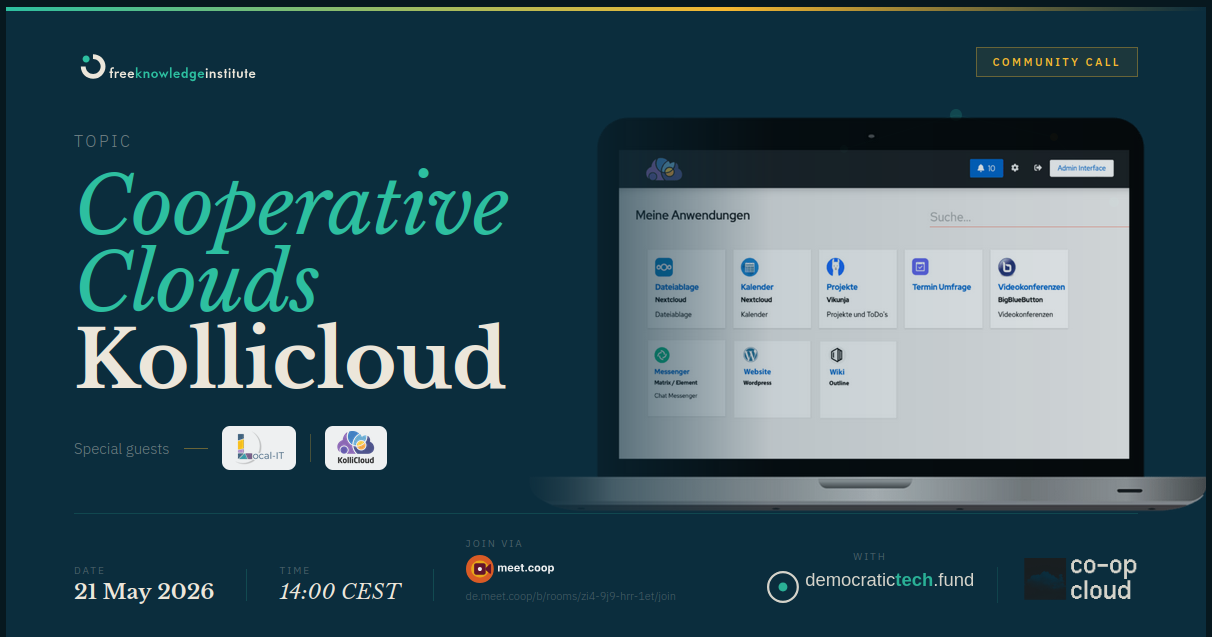
[← View the session announcement] [▶ Watch the recording] · [📄 Read the slides] · [📝 Read the transcription]
Two weeks after our community call with LaSuite.coop showed what a cooperative model for public-sector cloud services could look like at national scale, we turned to the other end of the telescope: what does sovereign digital infrastructure look like for a volunteer fire brigade, a queer youth organisation, or a local environmental network — groups with no IT department, minimal budgets, and real needs?
The answer, it turns out, is KolliCloud. And it is already running.
Who Is Behind It
KolliCloud is developed by Local-IT e.V., a small non-profit association based in Germany with around 35 members and six part-time positions. Local-IT’s mission is digital sovereignty and free software for civil society, pursued along two programme lines: education and community-building events (including their annual Barcamp), and free-software development for NGOs — of which KolliCloud is the flagship project.
The fact that Local-IT is itself a Verein — a German registered association, the same organisational form as most of their users — is not incidental. It means they are building for a use case they live every day. As Simon, who presented at the session, put it: “We are an association, so we are using the tools ourselves and providing tools for other associations. It’s easier to provide tools for a use case quite similar to our own.”
Nothing in the architecture prevents KolliCloud from serving other types of organisation — cooperatives, social enterprises, municipalities — and Local-IT is open to this where values align. But the association world is their home ground, and Germany has an enormous number of them.
What KolliCloud Is
KolliCloud is a ready-to-use integrated hosting toolkit for clubs, NGOs, and collectives. In practical terms it is a curated bundle of approximately fifteen free-software applications — Nextcloud, Authentik, Element/Matrix, Wekan, OnlyOffice, Vikunja, Vaultwarden, and others — deployed as a single integrated platform with single sign-on (SSO), automated backups, and monitoring included from the first minute.
That last sentence is worth dwelling on. SSO across fifteen applications — meaning one account, one login, one dashboard for everything — is the kind of thing that, if you have ever tried to set it up yourself, you know is fiendishly fiddly. It is one of the main reasons organisations stay on Google Workspace or Microsoft 365 despite wanting to leave: the alternative is not technically impossible, it is just time-consumingly difficult to wire together. KolliCloud makes it a non-issue.
Three deployment models are offered:
Self-hosting — you run it on your own infrastructure, using Local-IT’s public configuration repositories and guides (currently in German; English translation is in progress).
Managed hosting — Local-IT runs and maintains it for you at a subscription of €20–€200 per month (averaging around €60/month per instance, partly co-funded by public grants). For a small association, this is genuinely affordable.
Collective hosting — a middle path in which infrastructure is shared across organisations and co-governed by multiple admins. More on this below.
The Technical Secret: Building on the Configuration Commons
KolliCloud does not exist in isolation. It is built deliberately and explicitly on top of the Co-op Cloud Federation’s configuration commons — the shared ecosystem of community-maintained application recipes and the abra deployment tool that the federation has developed collectively.
Co-op Cloud solved the question of “how do I install one app” by building a commons of deployment configurations that any operator can use and contribute to. KolliCloud takes the next step and solves “how do I run all of them together as one coherent platform.” As Local-IT’s slides put it with admirable directness: “Self-hosting doesn’t remove the work — it shifts it.”
What KolliCloud adds on top of Co-op Cloud is a tool called Alakazam — the meta-configuration layer that makes the whole system manageable at scale.
Alakazam: The Orchestration Layer That Changes the Economics
Alakazam is, in Simon’s own description, what you need when “managing dozens of .env files by hand breaks.” Local-IT currently runs around 230 deployed applications across their managed instances. Without Alakazam, updating all of them would require manual intervention on each. With it, the process is a handful of commands.
The key insight behind Alakazam is hierarchical YAML configuration with inheritance. You define defaults once — which apps to deploy, which subdomains to use, SMTP settings, version pins — and each individual instance only needs to specify what differs from those defaults. Crucially, Alakazam also understands combinations: if you declare that an instance should have both Authentik (the SSO provider) and Nextcloud, Alakazam automatically applies the correct integration configuration to both, without you having to look up which environment variables need to match.
The update workflow this enables is genuinely impressive. Local-IT deploys every application upgrade to their staging environment first, lets it run for two weeks, and — if no problems emerge — pushes the update to all production instances with a single command. Moritz ran this process across all 230 applications a month before the session. Total effort: a few hours.
This matters because maintenance cost is usually the killer for small hosting providers and community operators. If upgrading fifty instances takes fifty times the work, it becomes unaffordable. If it takes roughly the same time regardless of instance count, the economics of community hosting transform entirely.
Alakazam has recently been recognised beyond Local-IT’s own operations: the Co-op Cloud Federation passed Federation Resolution 037, formally adopting Alakazam as an official Co-op Cloud project. This is a significant endorsement — it means the wider federation community is invested in developing it further, and that the methodology Local-IT pioneered can propagate across the entire ecosystem.
A Live Deployment — Under Pressure
The session included a live demonstration that became, in the best possible way, an illustration of both the tool’s power and the honest roughness of early-stage infrastructure work.
Simon set out to deploy a fully configured KolliCloud instance for the Democratic Tech Fund — fourteen applications, SSO wired together, backups configured, monitoring in place — live in front of the group. A small incident occurred early on: an ampersand (&) in the initial password caused a parsing error. Once identified and corrected, the deployment continued cleanly. By the end of the session, the instance was running.
The login page appeared at login.dtf.dev.kolli.cloud. Wouter confirmed it was up. The dashboard showed the full suite of applications, accessible through a single account.
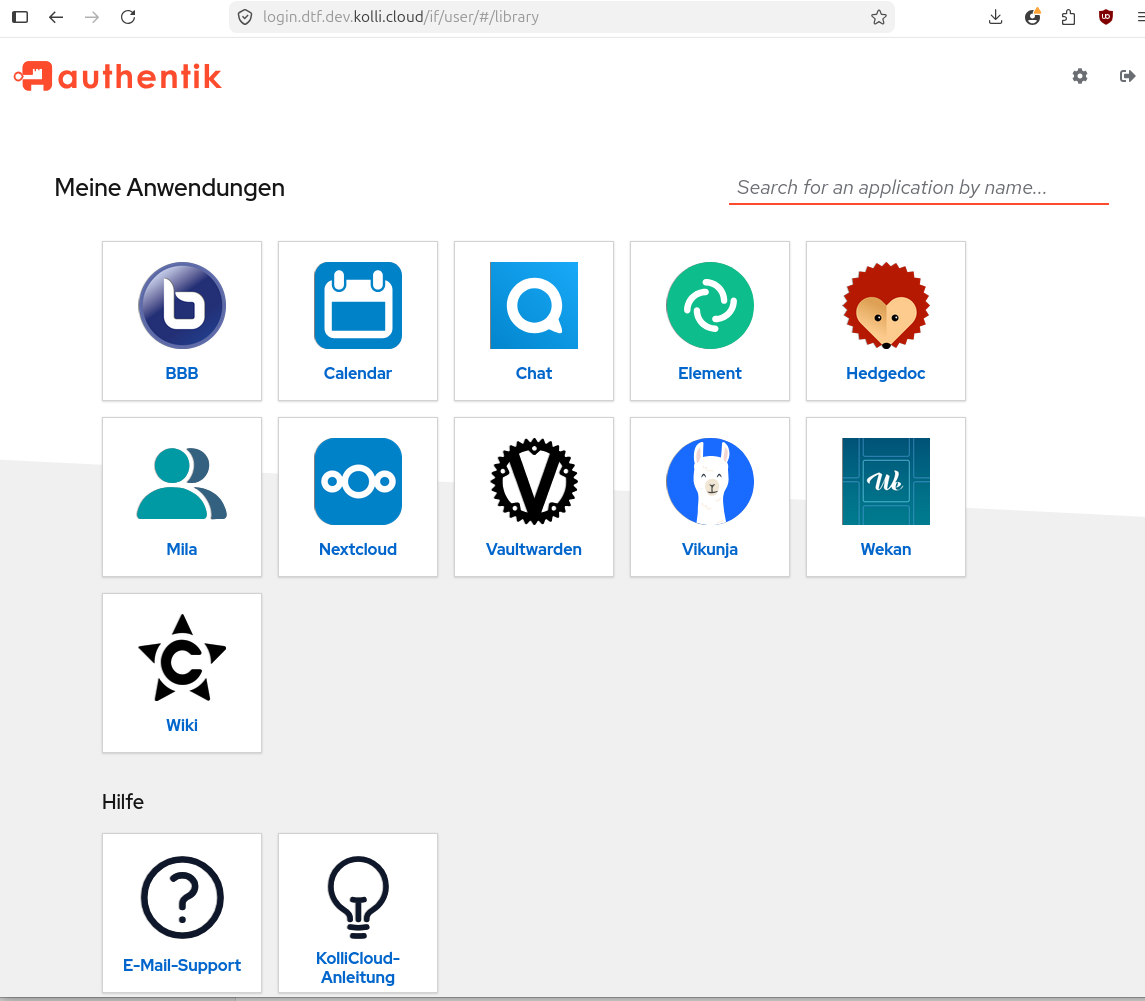
Total time from empty server to running platform: under thirty minutes — consistent with Local-IT’s own documented benchmark of under thirty minutes for a new instance including VM, backup, and monitoring. As Simon noted afterwards, this is proof that the system works, while also being honest that it still needs polish before it is fully turnkey for others to operate independently.
Who Is Already Using It
The most vivid example from the session was Lambda Bundesverband — Germany’s largest queer youth organisation, for which they set up the queer support cloud service. The entire organisation has migrated to free tools hosted on KolliCloud. But beyond basic file sharing and communication, their setup demonstrates what integrated sovereign infrastructure can look like in practice: their support service, through which young queer people can reach out for help, runs on a Zammad ticketing system integrated with Matrix/Element and a Signal bridge, so that volunteers respond to support requests directly from their chat client. The whole stack runs on KolliCloud. “KolliCloud solved the hosting problem for a small, financially constrained org,” their contact Valentin said — simply and accurately.
Other users include a volunteer fire brigade and various social organisations, some with over 100 user accounts. The profile is consistently the same: organisations with real collaborative needs, no dedicated IT staff, and a genuine desire to operate on tools they trust and control.
The Collective Hosting Model and Where This Is Heading
Perhaps the most interesting and underdeveloped idea in KolliCloud’s current architecture is the collective hosting model — what Simon described as “the same idea as Co-op Cloud, one layer down.”
Currently, seven members are hosting seven instances on a shared framework, with multiple admins holding access to the same infrastructure. The practical benefit is mutual cover: if one administrator is unavailable, others can step in. As Simon described it: “A couple of people have admin rights and SSH keys on a server with, say, seven VMs. If I’m going on holiday, someone else can help if my community’s infrastructure breaks.” This is the beginnings of federated mutual aid for small-scale hosting, applied not at the application layer (where the federation already operates) but at the infrastructure layer.
The observation that followed from the floor is worth quoting directly: if each community in the network runs a cloud like this, a genuinely federated cloud — distributed, community-governed, resilient — is not far away.
The Economics: Honest Numbers
Local-IT has received approximately €540,000 in development funding since 2021, drawn from German public and civic sources including the Akademie für die ländlichen Räume (rural civic infrastructure programmes), DSEE (Deutsche Stiftung für Engagement und Ehrenamt), Kreis Ostholstein, Stadtwerke Eutin, DigitalHub.SH, and the Fernsehlotterie.
Managed instances are priced at €20–€200 per month, averaging around €60 — though Local-IT estimates they need around 500 instances to sustain two to three part-time positions. They are not there yet. This is the central economic challenge of the cooperative hosting model: the per-unit costs are low, but reaching the scale needed for sustainability requires either many more users, additional grant support, or both. A shared administration model, where hosting responsibility is distributed across a wider community, is one path toward making the economics work without either growing into a large centralised provider or depending indefinitely on project grants.
The question of long-term economic sustainability was raised directly in the Q&A by d1 from Co-op Cloud: “We know the economics of hosting are difficult; we’re approaching some of the most underfunded parts of society and asking them to pay us for something they get ‘for free’. How can we make this sustainable?” Simon’s honest answer: “We need to work on this more.” The mutualization of labour — sharing the operational work across a community of administrators — is seen as a key part of the answer, but it is work in progress.
What Needs to Happen Next
KolliCloud is real, working, and — for the right communities — already deployable today. The self-hosting guides are public; the managed hosting is open; the collective hosting model is being built out. Alakazam is now an official Co-op Cloud project with federation-wide backing.
What the ecosystem still needs, and what the Democratic Tech Fund is trying to help build, is the social infrastructure around the technical one: more operators running KolliCloud clusters, more organisations sharing hosting responsibility, more communities contributing to the Co-op Cloud recipe commons that KolliCloud depends on. When more organisations join, the maintenance does not multiply — that is the whole point of a configuration commons.
The session also surfaced a new project: Mila, Local-IT’s open-source members-management tool for associations, built because existing options are too complex, too expensive, or too rigid. Mila integrates with Authentik via OIDC, supports custom fields, fee tracking, self-service membership applications, role-based access control, and accounting integration — all with WCAG 2.1 AA accessibility and a GDPR-first data model. It is in early release and contributions are welcome at git.local-it.org/local-it/mitgliederverwaltung.
Get Involved
If your organisation — or a community you work with — is looking to migrate away from Big Tech tools, or if you are interested in running cooperative cloud infrastructure for others, we encourage you to explore:
- KolliCloud at kollicloud.de — self-hosting guides, managed hosting, and the configuration repositories
- Co-op Cloud at coopcloud.tech — the federation and recipe commons that KolliCloud builds on
- Alakazam at git.coopcloud.tech/toolshed/alakazam — the orchestration layer, now an official federation project
- Mila at git.local-it.org/local-it/mitgliederverwaltung — membership management for associations
- Local-IT directly at info@local-it.org
And if you want to support the broader work of building social capacity for digital autonomy, the Democratic Tech Fund is the place to do it — contributions of any size are welcome at opencollective.com/democratictechfund.
The infrastructure is ready. The community is growing. Another world is not only possible — it is running on a Debian VM with Docker Swarm and fourteen apps behind a single login.
The Free Knowledge Institute community call with KolliCloud and Local-IT took place on 21 May 2026 via Meet.coop, organised with the Democratic Tech Fund and the CoopCloud Federation. Many active members of the Co-op Cloud Federation were present and contributed to the shared notes from which this article draws. The recording, slides, and full transcription are linked above.
This call series is ongoing. If you are building cooperative or commons-based digital infrastructure and would like to present at a future session, get in touch.